
3-D force-balanced magnetospheric configurations
Abstract. The knowledge of plasma pressure is essential for many physics applications in the magnetosphere, such as computing magnetospheric currents and deriving mag-netosphere-ionosphere coupling. A thorough knowledge of the 3-D pressure distribution has, however, eluded the community, as most in situ pressure observations are either in the ionosphere or the equatorial region of the magnetosphere. With the assumption of pressure isotropy there have been attempts to obtain the pressure at different locations,by either (a) mapping observed data (e.g. in the ionosphere) along the field lines of an empirical magnetospheric field model, or (b) computing a pressure profile in the equatorial plane (in 2-D) or along the Sun-Earth axis (in 1-D) that is in force balance with the magnetic stresses of an empirical model. However, the pressure distributions obtained through these methods are not in force balance with the empirical magnetic field at all locations. In order to find a global 3-D plasma pressure distribution in force balance with the magnetospheric magnetic field, we have developed the MAG-3-D code that solves the 3-D force balance equation  computationally. Our calculation is performed in a flux coordinate system in which the magnetic field is expressed in terms of Euler potentials as
 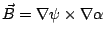 . The pressure distribution,
  , is prescribed in the equatorial plane and is based on satellite measurements. In addition, computational boundary conditions for ψ surfaces are imposed using empirical field models. Our results provide 3-D distributions of magnetic field, plasma pressure, as well as parallel and transverse currents for both quiet-time and disturbed magnetospheric conditions.
Key words. Magnetospheric physics (magnetospheric configuration and dynamics; magnetotail; plasma sheet)


